Quick answer
Cold-weather tear-offs scheduled into Chinook windows, shingles stored warm and hand-sealed course by course, and the same 10-year written workmanship warranty in January as in July.
Estimates by phone: (587) 804-9266 · Good Roofing · Calgary-owned since 2014 · 10-year workmanship warranty.
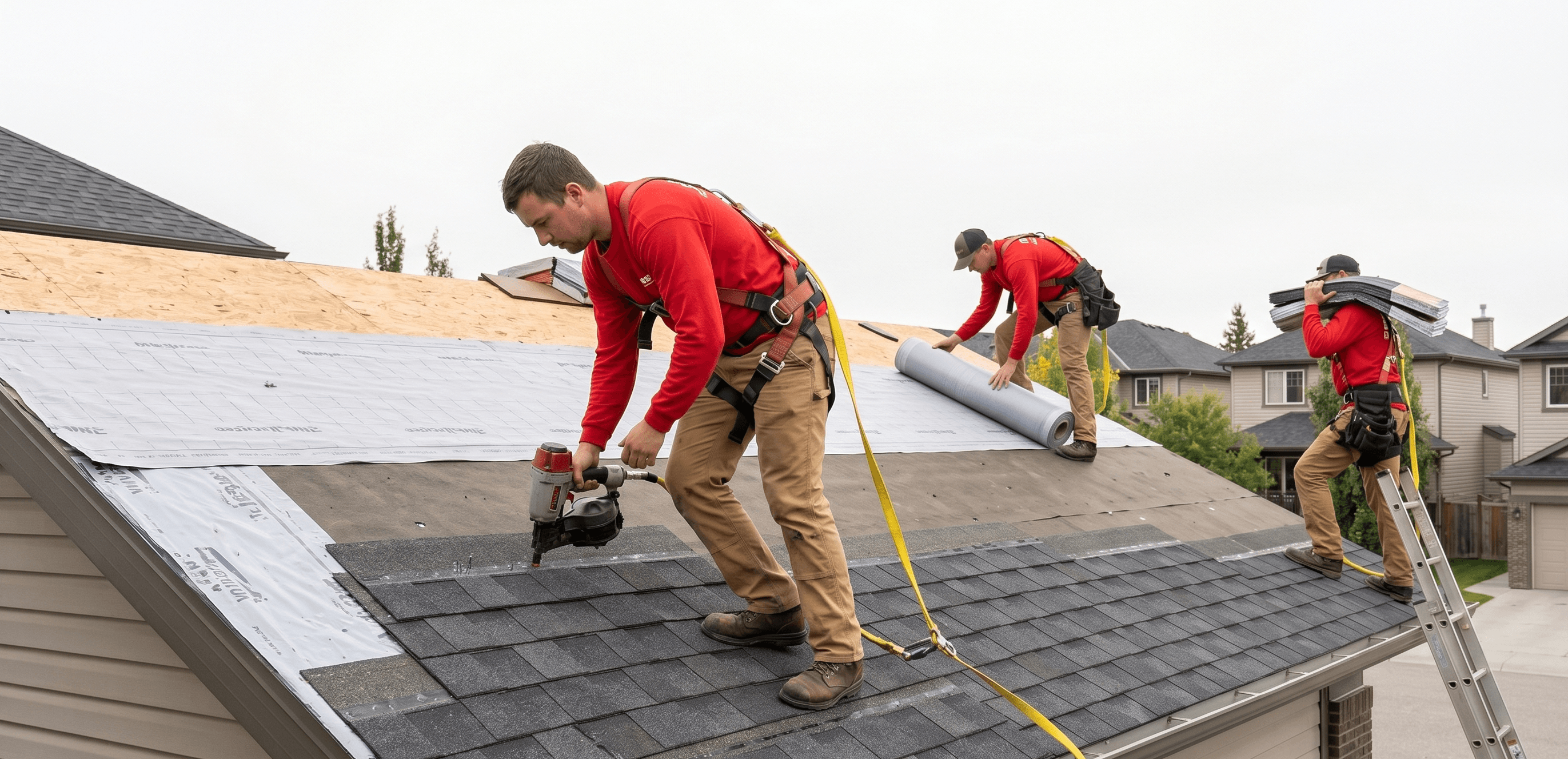
Yes. A Calgary roof can be replaced in winter, and a cold-weather install done to the shingle manufacturer’s instructions performs the same as one done in July. Three things change. The crew clears snow and frost off the deck before any underlayment goes down, shingles are stored warm and handled carefully because cold asphalt cracks, and new courses are hand-sealed because factory adhesive strips do not bond below about 10°C. Calgary also has a scheduling advantage: Chinooks regularly lift winter afternoon temperatures above freezing, and most single-family re-roofs take 1–2 working days, so a replacement fits inside one mild spell. The Calgary pages that rank for this question today agree that winter installs work. None of them tell you which roofs should go now and which should wait, which shingle lines handle a cold install best, or how winter timing affects the 365-day completion deadline on a hail claim. This page covers all three. Good Roofing has coordinated 2,800+ Calgary-region roofs since 2014 and holds 4.9★ from 237 verified reviews.
01 · Section
Quick answer — the 60-second version (citation-ready)
02 · Section
What cold weather does to a roof install, and how a winter crew handles it
- 01Brittle shingles. Bundles are kept in a heated trailer or garage until they go up, carried flat, and never bent over a ridge or rake cold. Cracked shingles are thrown out, not installed.
- 02Adhesive that will not activate. The factory sealant strip needs sun and warmth to bond. Below about 10°C it stays inert, so the crew hand-seals each course with roofing cement. Without it, the first Chinook gust lifts the tabs before spring ever arrives.
- 03Nail-gun pressure. A cold, stiff shingle is easier to blow through. Crews turn compressor pressure down so nails sit flush with the shingle surface instead of cutting the mat.
- 04A frosty or icy deck. Self-adhered ice-and-water membrane will not stick to frost. The deck is swept dry, and membrane goes down in the warmest hours of the day.
- 05Short days. Calgary gets under eight hours of daylight around the December solstice. Crews open only as much roof as they can close and seal before dark, so no section of deck sits exposed overnight.
03 · Section
Replace this winter or wait for spring? A Calgary decision guide
- 01Replace now: active leaks through worn-out shingles. Every melt pushes water into the deck and insulation. Rotten sheathing found in April adds cost that a January tear-off would have avoided.
- 02Replace now: missing or creased shingles across several slopes. Spot repairs on a roof whose shingles have lost their seal tend to fail at the next windstorm. Our wind damage guide explains how to tell.
- 03Replace now: an approved hail claim. Many Alberta policies require the work to be completed within 365 days of the loss for full replacement-cost recovery. A roof hit in a summer storm and still waiting in February is running out of calendar.
- 04Replace now: a home sale or purchase. A buyer’s inspector will flag a failing roof in any month, and a fixed written quote settles the negotiation faster than a spring promise.
- 05Wait: a sound roof getting a planned upgrade. If the roof is dry and holding its shingles, a spring install gives the adhesive strips summer heat to bond on their own and gives you more choice of dates.
- 06Wait: most low-slope membrane work. EPDM adhesives and seam primers carry tighter temperature limits than shingles. Flat-roof leaks get a temporary repair now and full replacement when it warms up. See flat roof repair.
04 · Section
How a winter re-roof runs, step by step
- 011. Inspection and fixed quote. A drone inspection photographs every slope without anyone walking on a snowy roof. We don't quote “starting at” prices. Every Calgary quote is fixed, written, and signed.
- 022. Booking the window. We watch the forecast for a run of dry days with daytime highs near or above freezing and moderate wind, then confirm the start date with you a day or two ahead.
- 033. Snow removal and tear-off. Snow comes off first, then the old roof comes off to the deck. We don't roof over existing shingles. Every job is a full tear-off down to the deck.
- 044. Deck inspection. Soft or delaminated sheathing is replaced before anything goes on top of it. Winter is when ice-dam rot along the eaves shows up most clearly.
- 055. Ice-and-water shield and underlayment. Membrane at the eaves, valleys and around every penetration, then synthetic underlayment across the field.
- 066. Shingles. Warm-stored Class 4 shingles, six nails each in the manufacturer’s nailing zone, hand-sealed course by course, with sealed starter strips at every eave and rake.
- 077. Ventilation check. Ice dams start with heat escaping into the attic. Intake and exhaust venting are balanced before the ridge closes. Our attic ventilation page covers the details.
- 088. Cleanup. Magnetic sweeps of the driveway and yard. Snow hides nails, so ask your roofer to sweep again once the yard melts.
05 · Section
Which shingles handle a cold-weather install best
06 · Section