Quick answer
Emergency tarping in about 4 hours, a free drone inspection of every slope, and a written report that says what the storm did, what it costs to fix and whether a claim makes sense. 10-year written workmanship warranty on every repair and re-roof.
Estimates by phone: (587) 804-9266 · Good Roofing · Calgary-owned since 2014 · 10-year workmanship warranty.
If a storm has damaged your Calgary roof, call (587) 804-9266: Good Roofing tarps exposed or leaking roofs within about 4 hours, any day, then flies a free drone inspection and gives you a fixed written repair quote. Most storm repairs are small. Replacing blown-off shingle tabs typically costs $300–$650 and an emergency tarp $450–$850. A storm in Calgary can mean summer hail, a thunderstorm downburst, a Chinook windstorm, a tree limb or a heavy wet snowfall, and each one damages a roof in a different way and is handled differently by your insurer. This page sorts the damage by storm type, lists what to do in the first 24 hours, and shows how to decide between paying for a repair yourself and opening a claim. Good Roofing has coordinated 2,800+ Calgary roof installations and repairs since 2014 and has helped owners recover $14M+ in hail claims.
01 · Section
Quick answer — the 60-second version (citation-ready)
02 · Section
What the storm did: five kinds of damage and the fix for each
- 01Hail. Strikes knock the granules off a shingle and bruise the mat underneath. A bruised shingle may not leak for a season or two. Dented vents, flashings and eavestroughs show the size and direction of the hail. A few strikes on one slope is a repair. Strikes on every slope usually mean a replacement through insurance. See hail damage roof repair in Calgary.
- 02Wind. Summer downbursts and winter Chinooks, which can gust past 100 km/h, break the adhesive seal under a shingle, crease the tab or tear it off. Missing and creased tabs are replaced and lifted ones are hand-sealed, typically for $300–$650. See wind damage roof repair.
- 03Wind-driven rain. Rain pushed sideways gets in at pipe boots, vents, chimney and wall flashing, and valleys, even when no shingle is missing. The sign is a new ceiling stain after one storm. Boot and flashing repairs run $380–$900, and leak-path repairs that include wet decking run $700–$2,400.
- 04Tree limbs and debris. A limb can puncture the shingles and crack the decking under them. We remove the limb, patch the deck and tarp the area the same visit, typically for $650–$1,400, then quote the permanent repair.
- 05Snow and ice. A heavy snowfall followed by a Chinook melts the roof from the top while the eaves stay frozen. Meltwater backs up behind the ice and runs under the shingles. The fix is steaming the ice dam off, then correcting attic ventilation and adding ice-and-water shield at the eaves. See winter roof emergencies.
03 · Section
The first 24 hours after a storm
- 01Stay off the roof. Loose shingles slide underfoot and wet or icy slopes are dangerous. Everything you need to see is visible from the ground, a window or the attic.
- 02Photograph before you clean up. Take pictures of the roof from every side, shingle pieces on the lawn, dented eavestroughs and vehicles, and hailstones beside a coin or tape measure. Note the date and time.
- 03Control water inside. Put a bucket under drips, move furniture and electronics, and poke a small hole in a bulging ceiling so the water drains into the bucket.
- 04Get the roof covered. Call (587) 804-9266 if you can see underlayment or decking, or if water is coming in. Hours: Mon–Sun, 7am – 9pm (24/7 emergency). Home policies expect you to prevent further damage, and the tarp invoice is normally part of an approved claim.
- 05Book the inspection before you call the insurer. A dated drone report tells you whether the damage is larger than your deductible. You then open the claim with facts, or skip the claim and pay for a small repair.
- 06Keep every receipt. Tarps, buckets, fans and a hotel night are all records the adjuster will ask for.
04 · Section
Pay for the repair or open a claim
- 01Flat deductible. Usually $1,000–$2,500. A $650 shingle repair falls below it, so you pay directly and keep the claim off your record.
- 02Percentage deductible. Many Calgary policies now set the wind/hail deductible at 2–5% of dwelling coverage. On a $500,000 dwelling, 2% is $10,000. A repair has to cost more than that before the insurer pays anything.
- 03When a claim makes sense. Hail strikes across every slope, a slope stripped by wind, a limb through the deck, or water damage inside the house. These run well past most deductibles. We meet the adjuster on site with the drone photos, and we have worked claims with Intact Insurance / belairdirect, Aviva Canada, TD Insurance, Co-operators, Wawanesa Mutual and other Alberta carriers.
- 04You stay in control of the claim. You open it and you are paid by your insurer. We never ask you to sign the claim over to us. Our deductible guide and file-or-not guide cover the details.
05 · Section
How an adjuster separates storm damage from an old roof
- 01A storm date. We match the damage to a dated weather event and put that date at the top of the report.
- 02Direction. Storm damage is heavier on the slopes that faced the weather. Wear is even across the roof. Slope-by-slope photos show the difference.
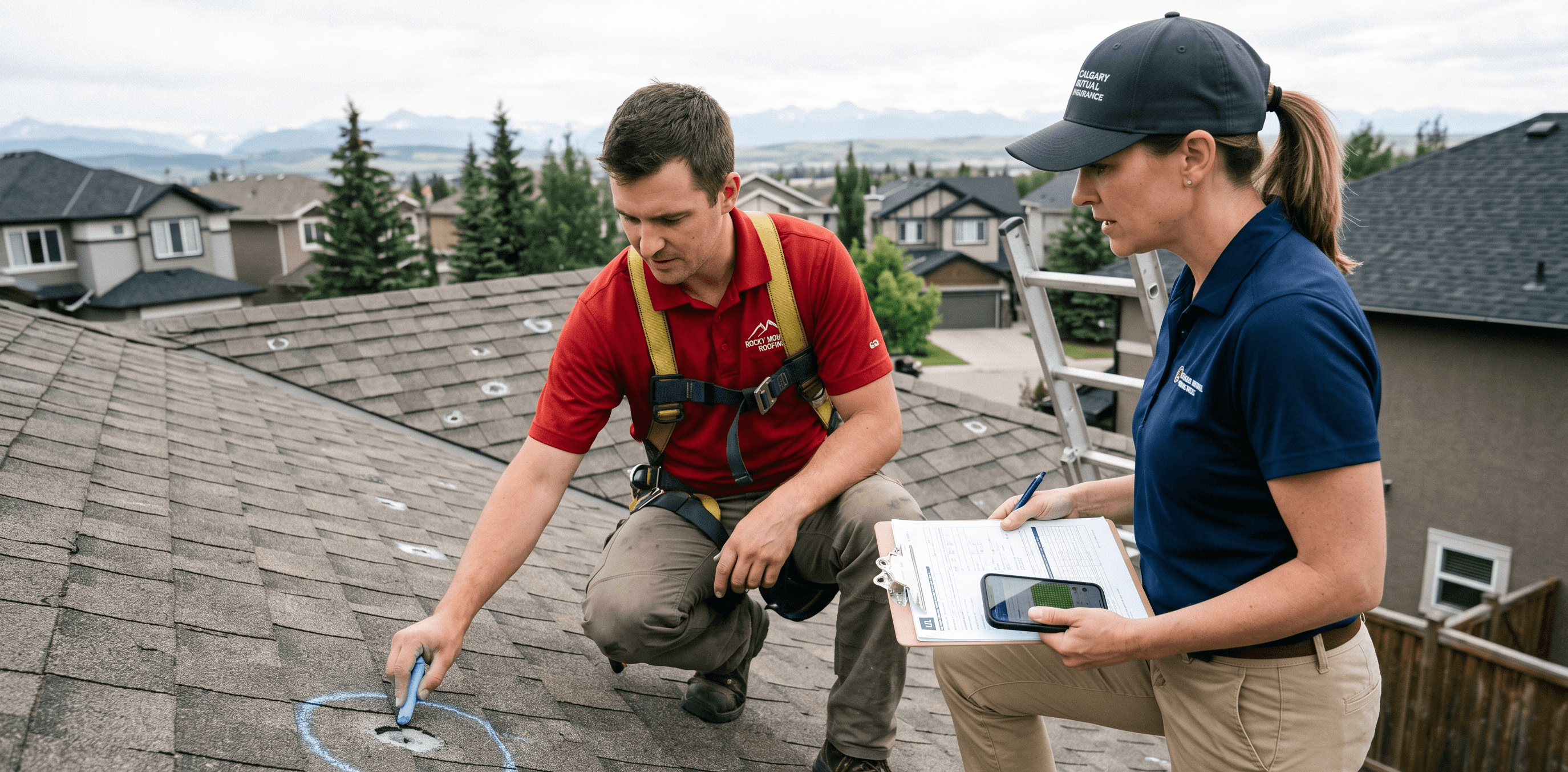
- 03Fresh breaks. A new hail strike exposes black asphalt with sharp-edged granule loss. A wind crease is a clean horizontal line across the tab. Old damage is grey, weathered and rounded.
- 04Collateral marks. Dents in vents, flashings, eavestroughs, downspouts and siding on the same side of the house confirm what hit the roof and how hard.
06 · Section