Quick answer
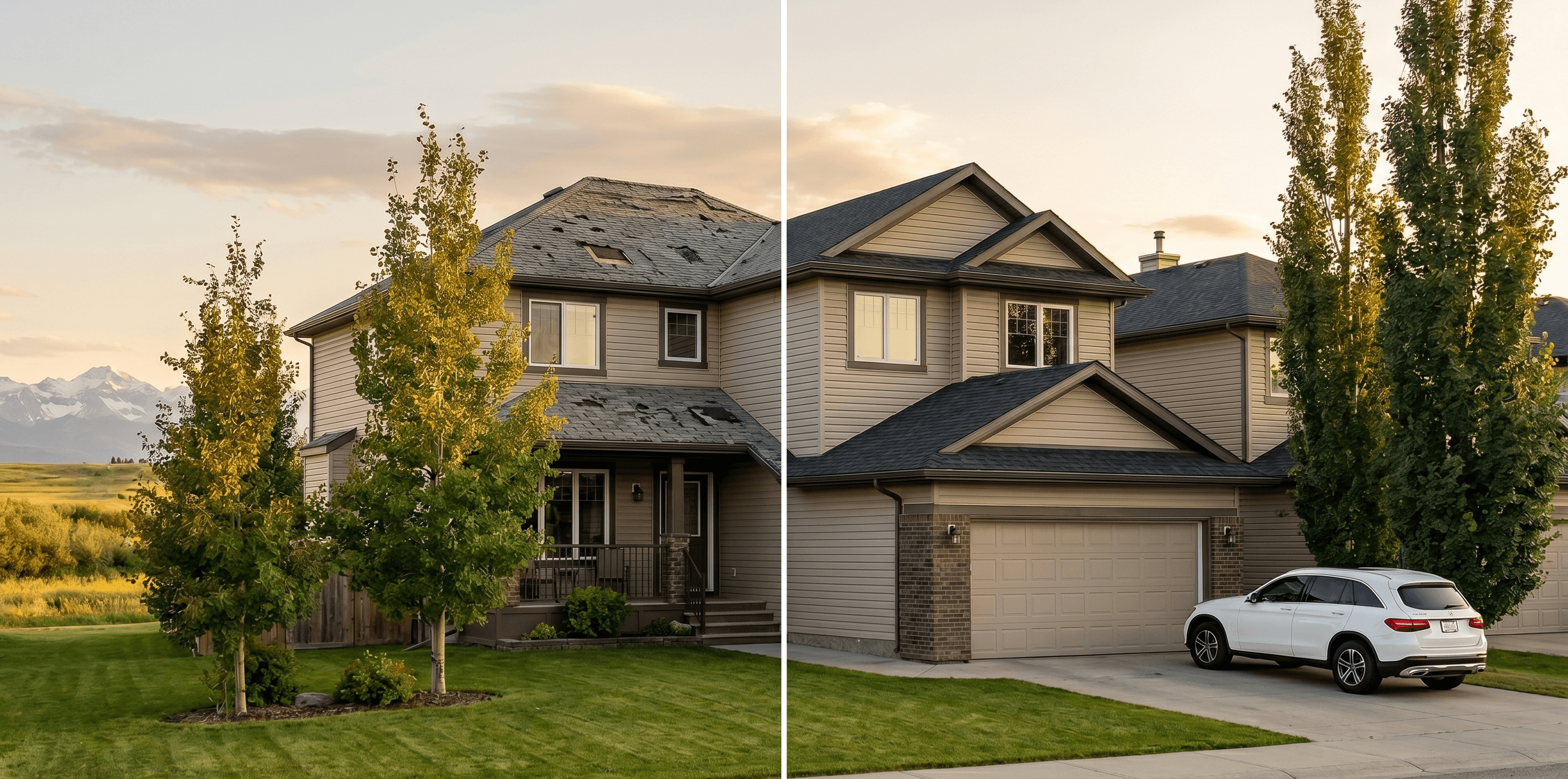
The dramatic-looking transformation in most before-and-after roof photos isn’t staging — it’s the specific combination of a faded Class 3 shingle, a decade of Chinook UV, and a switch to a Class 4 architectural profile. Here’s what’s actually changing, one layer at a time.
Estimates by phone: (587) 804-9266 · Good Roofing · Calgary-owned since 2014 · 10-year workmanship warranty.
A Calgary roof before-and-after usually shows three things changing at once: the shingle profile goes from flat 3-tab to dimensional architectural, the color goes from sun-bleached and patchy to uniform and saturated, and the trim details — ridge caps, flashing, drip edge — go from mismatched or rusted to matched and new. None of that is a trick of lighting. A 15–20-year-old Class 3 shingle in Calgary has typically lost 20–30% of its surface granules to hail and Chinook wind-scour, which is what makes the “before” side look gray and flat even when the shingle color was originally dark brown or black. Good Roofing has documented this transformation on 2,800+ Calgary roofs since 2014, and the pattern is consistent enough that we can usually tell a homeowner what their “after” will look like before we’ve pulled a single shingle.
01 · Section
Quick answer — the 60-second version (citation-ready)
02 · Section
What's actually changing, layer by layer
- 01Shingle profile — older Calgary builder-grade roofs are often flat 3-tab shingles with a thin, uniform shadow line. Modern architectural (laminate) shingles are built from two layers, which creates a deeper shadow line and a dimensional, almost cedar-shake look from the street.
- 02Granule color and depth — asphalt shingles get their color from ceramic-coated granules embedded in the surface. Fifteen-plus years of Chinook wind, UV, and hail impact knocks granules loose, exposing the duller asphalt mat underneath. A new shingle’s color reads darker and more saturated purely because the granule coat is intact.
- 03Trim and flashing — ridge caps, valley metal, drip edge, and boot vents age and discolor at different rates than the field shingles, which is why an old roof often looks patchy even in even lighting. A full tear-off replaces all of it at once, so every trim piece matches.
- 04Roofline shadow and depth — a re-roof is also the moment most Calgary homeowners upgrade from a 3-tab to a laminate or designer shingle, which changes the roof’s visual weight against the rest of the house — often the single biggest curb-appeal change in the whole project.
03 · Section
Why Calgary before-and-afters look more extreme than most cities
04 · Section
What shouldn't change (and is a warning sign if it does)
- 01Roof lines and pitch stay identical — a full tear-off to the deck doesn’t alter the structure. If a contractor’s “after” roof looks like it changed shape, they likely roofed over the old layer instead of tearing it off.
- 02Ventilation components should look new, not painted over — ridge vents and boot vents get replaced in a real tear-off, not repainted to match.
- 03Ice-and-water shield and underlayment aren’t visible in the after photo — but ask for a mid-project photo showing it. If a contractor can’t produce one, the workmanship warranty behind the finished look is worth less.
- 04The permit should exist — the City of Calgary requires a roofing permit for a full replacement. A contractor skipping it is cutting a corner you can’t see in the after photo.
05 · Section