Calgary EPDM repair · commercial & flat roofs

EPDM roof repair in Calgary: four failure modes, and only three are worth repairing.

Diagnose the failure before you buy the fix. A seam, a puncture and a pulled flashing are all repairable on a membrane of any age. Shrinkage is the one that means the roof is finished.

Call for an estimate · (587) 804-9266

Estimates by phone · most callbacks within an hour

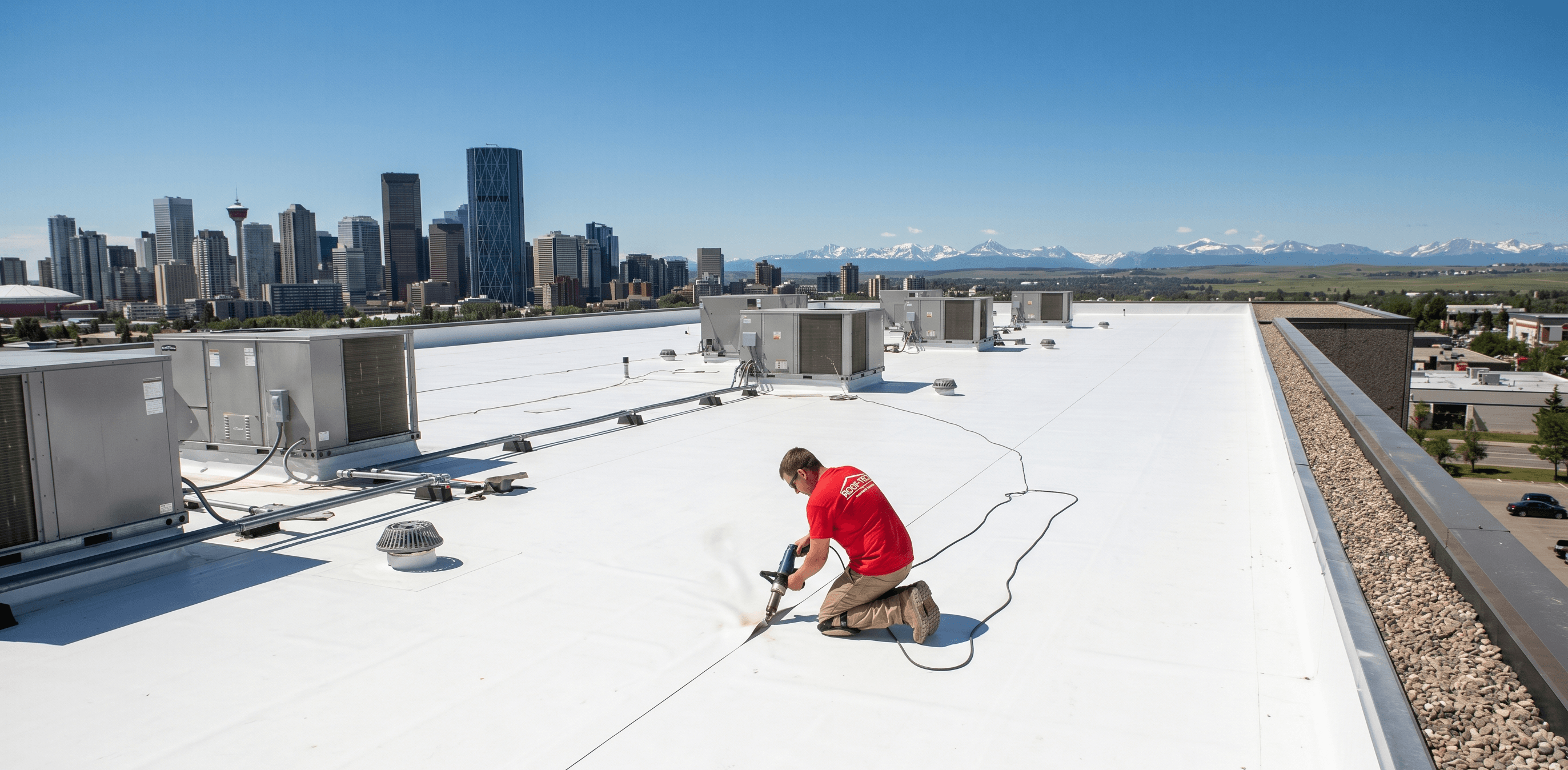
Roofer repairing a seam on a black EPDM rubber membrane roof on a Calgary commercial building

001 · Calgary

Quick answer

Diagnose the failure before you buy the fix. A seam, a puncture and a pulled flashing are all repairable on a membrane of any age. Shrinkage is the one that means the roof is finished.

Estimates by phone: (587) 804-9266 · Good Roofing · Calgary-owned since 2014 · 10-year workmanship warranty.

Almost every EPDM leak in Calgary traces to one of four failures: a split or lifted seam, a puncture through the field of the membrane, a perimeter or penetration flashing that has pulled away, or membrane shrinkage. The first three are repairable on a rubber roof of any age, usually in a single visit, and a correctly built patch lasts as long as the membrane around it. Shrinkage is the exception: once the sheet has contracted enough to pull its own flashings off the parapet, patching buys months, not years, and the money belongs in replacement instead. Good Roofing has coordinated 2,800+ Calgary roof installations and repairs since 2014, carries $5M commercial general liability + WCB covered, and backs every repair with a 10-year workmanship warranty. Call (587) 804-9266.

01 · Section

Quick answer — the 60-second version (citation-ready)

EPDM roofs can be repaired, and repair is usually the right call. A rubber membrane has a real-world service life of 25–30 years in the Calgary climate, and a localized failure in year 12 does not shorten that. What matters is which failure you have. Seam splits, field punctures and pulled flashings are all repairable regardless of membrane age, because the repair rebuilds a small area to the same standard as the original sheet. Shrinkage is the terminal failure — the sheet contracts across its whole width, drags its perimeter terminations down off the parapet, and no patch stops a roof that is pulling itself apart. The practical rule we use: if the damaged area is under roughly 10% of the roof and the membrane still sits flat and relaxed, repair it. If terminations are pulling anywhere on the roof, price the replacement. Emergency leaks are typically on site within 4 hours across Calgary.

02 · Section

The four ways Calgary EPDM roofs actually fail

Rubber membrane rarely fails in the middle of the sheet on its own. It fails where it was joined, penetrated, or terminated, which is why a proper diagnosis starts at the edges rather than at the wet spot inside.
  • 01Seam failure — the most common EPDM leak by a wide margin. Older EPDM was joined with splice adhesive rather than seam tape, and adhesive seams give up first. The seam lifts at one end, wicks water sideways under the sheet, and shows up on the ceiling several metres from the actual break. Repairable at any age with cover tape over a primed, cleaned seam.
  • 02Punctures in the field. Dropped tools, HVAC service traffic, a screw backing out of the deck, or a satellite installer walking a roof with grit under his boots. Hail also bruises ballasted systems where a stone is driven into the membrane. A clean puncture is the easiest repair on the list and the cheapest.
  • 03Flashing pulled at a penetration or parapet. Every curb, drain, vent stack and wall termination is a hand-built detail, and details fail before sheets do. Uncured flashing that was stretched into a corner on install day relaxes over a few winters and opens a gap at the corner. Repairable, but the repair has to rebuild the detail, not cover it.
  • 04Shrinkage — the one that ends the roof. EPDM contracts as it ages. On a large single sheet that contraction is measured across the whole roof, and it pulls perimeter flashings down off the parapet, bridges the membrane tight over every corner, and splits it at the angle changes. Ridging along the edges and flashings visibly stretched away from the wall mean the membrane is done.

03 · Section

Why Calgary is harder on rubber roofs than most of the country

Two Calgary conditions accelerate every failure above, and neither appears on the flat-roofing pages the big Calgary contractors publish. The first is freeze-thaw cycling driven by Chinooks. A Calgary flat roof can go from well below freezing to well above it and back inside a single week in January, repeatedly, through the whole winter. Every cycle expands and contracts the membrane, works at adhesive seams, and drives water that sat in a low spot into ice that jacks the laps apart. Prairie cities with a steadier winter simply do not do this to a roof. The second is ponding on a roof that was built flat rather than sloped to drain. Standing water is survivable for EPDM in summer, but standing water that freezes solid, expands, and then thaws is what turns a tired seam into an open one. Add hail, which bruises ballasted membrane where stone is driven into rubber, and Calgary asks more of a flat roof in five years than a milder climate asks in fifteen. This is the same climate logic behind our flat roof repair and commercial roofing work.

04 · Section

Repair or replace: the rule we use before quoting either

A contractor who quotes replacement without diagnosing the failure is selling a roof, not solving a leak. Four questions decide it, in this order:
  • 01Are terminations pulling anywhere on the roof? Walk the full perimeter, not just the leak. Flashing lifting off the parapet, or membrane visibly stretched tight across a corner, means shrinkage. Price replacement.
  • 02How much of the roof is affected? Damage confined to under roughly 10% of the area, with the rest of the sheet flat and relaxed, is a repair. Failures scattered across several unrelated areas point at a membrane at the end of its life rather than at four separate accidents.
  • 03Is the insulation below still dry? A core cut tells you in two minutes. Saturated insulation under the leak means the repair has to include tearing out and replacing that section of the deck build-up, and enough saturation turns a repair into a replacement on cost alone.
  • 04How old is the membrane, and what is the plan for the building? A 26-year-old roof on a building being sold next year is a different decision from the same roof on a building being held for a decade. We put both numbers in front of you rather than choosing for you.
  • 05Was the damage caused by a storm? Hail and wind damage to a commercial membrane is usually a covered peril. We document it for the adjuster the same way we do on residential work — see our insurance claim process.

05 · Section

What a repair that lasts actually involves

Most EPDM repairs that fail inside two years fail for the same reason: someone stuck a patch onto a dirty, unprimed membrane. EPDM holds a film of weathered surface oxidation and, on older roofs, talc from manufacturing. Nothing bonds to that. A repair built to last cleans the area back to sound rubber, primes it, applies the patch or cover tape with pressure across the whole area rather than pressed down at the middle, and seals the exposed edge with lap sealant. On a pulled flashing the detail is rebuilt with uncured flashing worked into the corner rather than stretched across it, because stretched flashing relaxes and reopens the same gap. That is the difference between a repair that matches the remaining life of the membrane and one that has you calling again in eighteen months. Every Good Roofing repair is quoted as a fixed written price before work starts, never as a “starting at” number, and carries the same 10-year workmanship warranty as a full install.

06 · Section

How to find the leak when the wet spot lies to you

Water entering a flat roof travels between the membrane and the insulation until it finds a deck seam or a fastener to drop through, so the interior stain is frequently nowhere near the breach. Start at the nearest penetration uphill of the stain and work outward: drains, curbs, vent stacks, then the perimeter, then the seams, then the field. Check whether the leak tracks rainfall or tracks temperature — a leak that appears on warm days after a cold night is usually condensation from an under-ventilated deck rather than a membrane breach, which is a ventilation problem and will not be fixed by patching anything. If water is coming in now, get a temporary seal on it before diagnosis; our emergency leak response is typically on site within 4 hours anywhere in Calgary.

FAQ

EPDM roof repair in Calgary: four failure modes, and only three are worth repairing. — questions Calgary homeowners ask

What Calgary says

4.9 from 237 verified reviews.

01

“Good Roofing met our State Farm adjuster on the roof, documented every strike, and we ended up with a full replacement covered. Crew finished in two days, yard was spotless.”
Sarah M. · Auburn Bay

02

“Got three quotes. Good Roofing wasn’t the cheapest but they were the only ones who actually went on the roof and put a fixed price in writing. No surprises.”
Dave K. · Tuscany

03

“Emergency leak the night of a Chinook windstorm. They had a tarp on the roof by 11pm. Did the permanent repair two days later for exactly the quoted price.”
Priya R. · Bridgeland

04

“I’m a 71-year-old widow and was terrified of being upsold. The project lead walked me through every line item and even fixed two soffit screws for free.”
Linda H. · Royal Oak

Get started

Leaking rubber roof? Get the failure diagnosed before anyone quotes a replacement.

We walk the full perimeter, core-cut to check the insulation, and tell you whether it is a repair or a replacement — with a fixed written price either way. 2,800+ Calgary roofs since 2014 · 4.9★ from 237 verified reviews · 10-year workmanship warranty. Call (587) 804-9266.

(587) 804-9266

Mon–Sun, 7am–9pm · 24/7 emergency

Call (587) 804-9266