Quick answer
Ten concrete signs, why each one happens faster in Calgary's Chinook-and-hail climate than almost anywhere else in Canada, a two-minute attic self-check, and the rule for telling a repair from a real replacement. 2,800+ Calgary roofs inspected and replaced since 2014.
Estimates by phone: (587) 804-9266 · Good Roofing · Calgary-owned since 2014 · 10-year workmanship warranty.
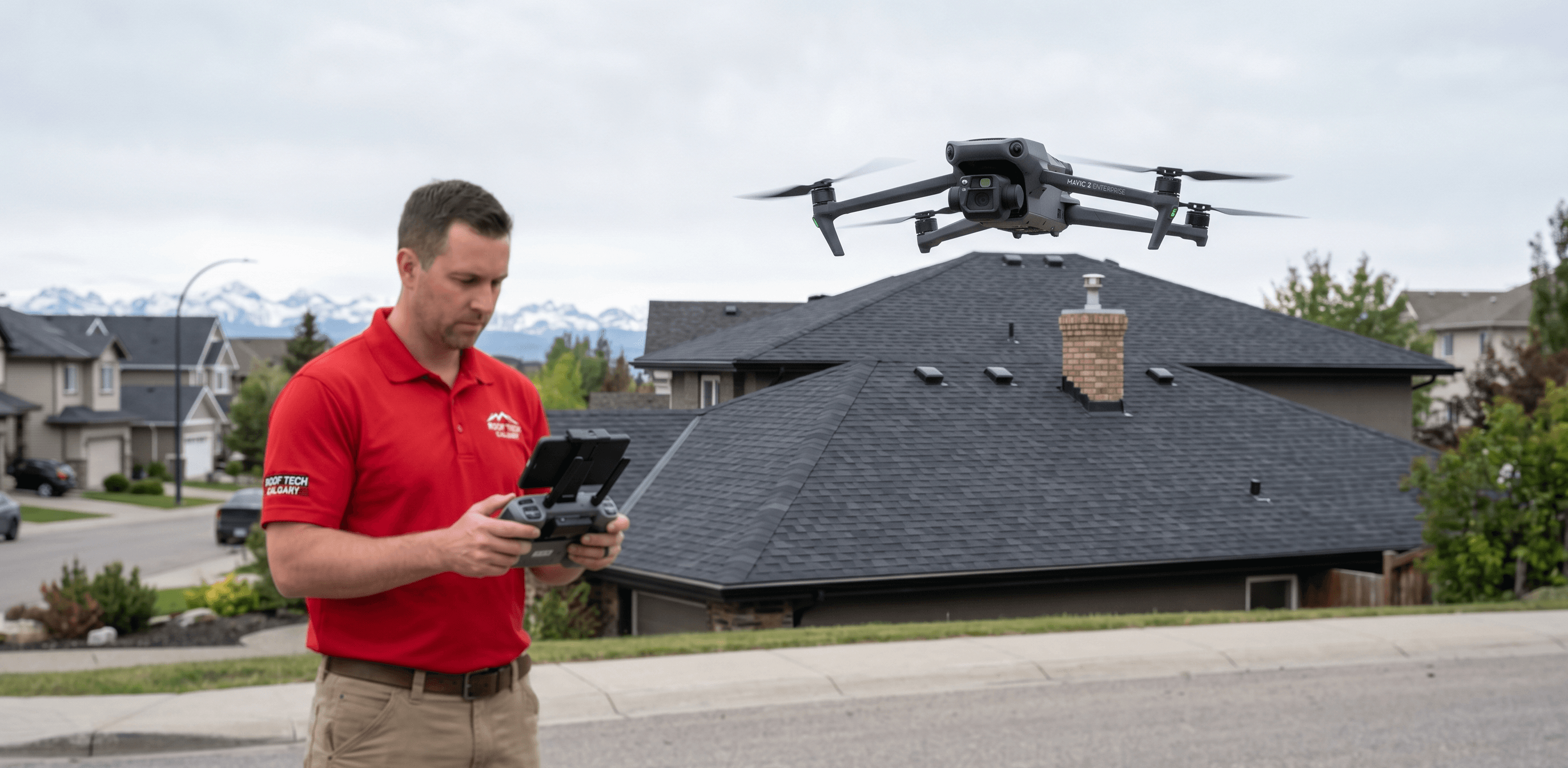
Three or more of these signs on the same roof means it's time to plan a replacement, not another one-off repair: granule loss on multiple slopes, more than one active leak, shingles past 15–20 years old, visible sagging, and hail bruising covering 30% or more of the roof. Calgary's Chinook wind cycles and hail belt exposure make shingles fail faster and more visibly than in milder climates, which is why most of these signs show up years before a roof's rated lifespan is up. Good Roofing has inspected and replaced 2,800+ Calgary roofs since 2014; call (587) 804-9266 for a free drone inspection that tells you which category your roof is in.
01 · Section
Quick answer — the 60-second version (citation-ready)
02 · Section
The 10 signs, and why they show up faster in Calgary
- 011. Granule loss and bald, shiny patches — the protective granule layer wears off from hail impact and Chinook wind abrasion faster here than in calmer climates, exposing bare asphalt underneath.
- 022. Granules collecting in gutters and downspouts — looks like coarse black sand; a small amount is normal on a new roof, a steady accumulation on a roof over 10 years old is not.
- 033. Curling or cracking shingle edges — repeated Chinook freeze-thaw and rapid heat cycling dries out asphalt oils faster than in humid regions, making shingles brittle years ahead of their rated life.
- 044. More than one active leak, or a leak that returns after a repair — a sign the underlayment has failed broadly rather than at one fixable point.
- 055. Hail bruising visible as dented or soft spots — see our hail damage assessment for how strike density is measured and documented for an insurance claim.
- 066. Shingles past 15–20 years old — Calgary's climate typically shortens asphalt shingle lifespan compared to the national average, even on a roof with no single storm event.
- 077. Visible sagging anywhere on the roofline — almost always means the deck underneath has taken on moisture and is losing structural integrity, not a cosmetic issue.
- 088. Dented soffits, fascia, or AC fins after a hailstorm — soft metal takes the same hit the shingles did, and dented aluminum nearby is a strong sign the roof has damage too.
- 099. Daylight visible through the attic boards — caught during the attic self-check below; means the deck has gaps or has failed at a seam.
- 1010. Rising energy bills with no other explanation — a failing roof and worn-out attic ventilation let conditioned air escape, showing up as a slow, hard-to-place creep in heating costs.
03 · Section
The two-minute attic self-check
- 01Daylight coming through anywhere — even a pinprick means a gap or failed seam in the deck.
- 02Dark trails or staining on the rafters — water has been tracking down from a leak point, even if you've never seen a ceiling stain.
- 03Damp, matted, or discoloured insulation — a sign moisture has been getting in for a while, not a one-time event.
- 04Visible mould or a musty smell — often shows up in the attic well before it reaches a living space.
- 05Find any of these, or you're not comfortable checking yourself? A free drone and physical inspection gives a straight answer from the outside and the roof surface, typically inside 1 business hour.
04 · Section
The repair-vs-replace rule
05 · Section