Quick answer
What hail damage actually looks like, the 5-minute ground-level check, what it costs in Calgary in 2026, and the Class 4 shingle that ends the cycle. $14M+ recovered across 2,800+ Calgary roofs.
Estimates by phone: (587) 804-9266 · Good Roofing · Calgary-owned since 2014 · 10-year workmanship warranty.
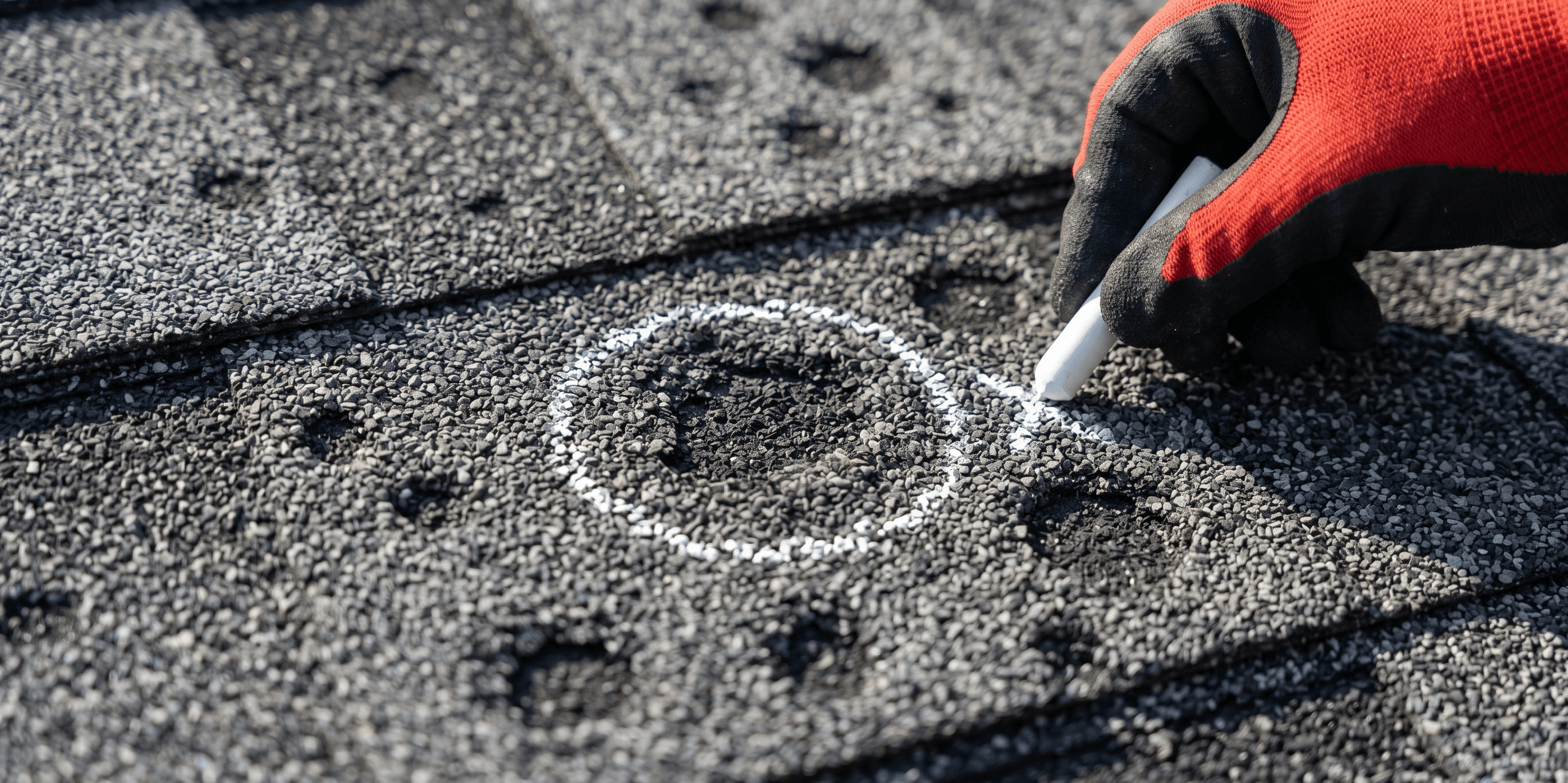
Hail damage on a roof shows up as round, bruised dents in the shingle mat, missing granules around each strike, fractured ridge caps, and dinged soft metals — eavestrough, downspouts, vent caps, and furnace flashings. In Calgary — Canada’s hail capital, the corridor insurers call "hail alley" running NE → SW across the city — a single August storm can write off every west- and south-facing slope on a 10-year-old roof in under 15 minutes. The 2024 Calgary hailstorm was the costliest natural disaster in Canadian history at over $3 billion in insured losses (Insurance Bureau of Canada), and the 2025 and 2026 seasons have both already produced reportable hail events on the NE quadrant. Good Roofing has recovered $14M+ in Calgary hail claims across 2,800+ roofs since 2014, and this page is the homeowner’s field guide: how to spot it, how to price it, what to do tonight, and the Class 4 impact-rated shingle that ends the every-three-years insurance-claim cycle.
01 · Section
Quick answer — the 60-second version (citation-ready)
02 · Section
What hail damage actually looks like on a roof — strike-by-strike
- 01Round bruised dents in the shingle mat. Hailstones are roughly spherical, so impacts on an asphalt shingle leave perfectly round soft spots roughly 1–5 cm across. Pressed with a thumb, a bruised shingle has a slightly spongy or “give” feel — the fibreglass mat underneath has been fractured even when the surface looks intact.
- 02Granule loss revealing black asphalt. The colored crushed-stone granules on the surface protect the shingle from UV. Hail strikes knock them loose, exposing the black asphalt underneath. Look in your eavestrough and downspout splash blocks for granule accumulation — a clear sign of an active strike count.
- 03Fractured or cracked ridge caps. The ridge cap (the bent shingles running along the peak) is the most exposed surface on the roof and the first to fracture. Cracks run perpendicular to the ridge and are usually visible from the ground with binoculars.
- 04Crushed soft-metal vent caps, B-vents, plumbing stacks, and chimney flashings. Soft metals deform under hail before shingles bruise. If your vent caps look dimpled or your aluminum flashings are dinged, the shingles above them are almost certainly bruised too.
- 05Dinged eavestrough, downspouts, garage doors, and A/C condenser fins. Hail damage is rarely isolated to the roof. Dents on your aluminum eavestrough and downspouts, on the garage-door panels, and especially on the soft aluminum fins of your air-conditioning condenser are all evidence the adjuster will record as collateral damage.
- 06Splatter marks on painted surfaces (the “hail signature”). After a storm, look at painted decks, deck rails, exterior trim, and the top side of fence boards for round dirt-blown discolorations the size of the stones. These wash off in the first rain but, photographed within 24 hours, are some of the most persuasive evidence on a claim file.
- 07What is NOT hail damage: blistering (heat / poor ventilation), curling or cupping (age), missing shingles in a stripe (wind), moss or algae streaking (organic), and granule loss confined to valleys and along eaves (normal wear). An honest Calgary roofer tells you when it’s not hail — and Good Roofing will, in writing, in under ${FACTS.metrics.averageResponseHours} business hour.
03 · Section
The 5-minute ground-level check (no ladder, no climbing)
- 01Walk the perimeter of your home. Look up at every slope, especially west- and south-facing. Use binoculars or a phone zoom. Photograph anything that looks like granule loss, missing tabs, or fractured ridge caps.
- 02Check the eavestrough and splash blocks for granules. A pile of crushed-stone granules in the splash block is the single clearest ground-level signal of an active strike count.
- 03Inspect every downspout for dents. Soft aluminum dimples easily — dents at random intervals along a downspout, especially on the side facing the storm track, are a strong hail signature.
- 04Photograph your A/C condenser fins. Bent aluminum fins on the condenser are visible at ground level and are a high-value collateral-damage line item on the claim.
- 05Walk to the alley and check the back of the garage roof and door. Garage door panels show dents at angle. Detached structures are usually on the same policy and are routinely missed by adjusters on the first walk.
- 06Check neighbour houses two doors either side. Hail damage is hyper-local — if both neighbours have visible damage, you almost certainly do. If neither does, the strike may have missed your property.
- 07Call a licensed Calgary roofer for a free drone inspection. Phone or web: (587) 804-9266. A drone inspection produces a written, time-stamped, geo-tagged damage report within 24 hours — the single most useful document you can have before you call your insurer.
04 · Section
What to do tonight, tomorrow, and this week
- 01Tonight (within 4 hours of the storm): walk the perimeter with a phone. Photograph everything from the ground — splatter marks on the deck wash off in the first rain and are gone forever after 24 hours. If water is actively entering, tarp from inside the attic, not the roof. Good Roofing’s emergency line responds within ${FACTS.metrics.emergencyResponseHours} hours.
- 02Tomorrow morning (within 24 hours): book a free drone inspection. Get the written, time-stamped damage report emailed before you call your insurer. Document the storm date and the Environment Canada weather event reference.
- 03Tomorrow afternoon: call your insurer to open the claim, with the damage report and storm date in hand. Get the claim number in writing. Ask the adjuster meeting to be coordinated with your roofer present on the roof.
- 04This week (days 3–14): meet the adjuster on the roof with your roofer present. This single step is non-negotiable — claims walked alone almost always come back light by $4,000–$7,000.
- 05Next week: if the adjuster’s scope is light, your roofer submits a written Xactimate or Symbility supplement for code upgrades (ice-and-water shield, drip edge, ridge venting), Class 4 impact-rated shingles, soft-metal collateral, and detached structures.
- 06Within 60–90 days: approved scope, ACV cheque issued, tear-off and install scheduled. Calgary install windows are tight in peak season (July–September) — book early.
- 07Within 365 days: work must be completed for full RCV (replacement-cost-value) recovery on most Alberta policies. Don’t let the depreciation holdback expire.
05 · Section
The Calgary cost picture — repair vs. claim vs. re-roof
- 01Out-of-pocket repair (no claim filed): $850–$2,200 for a single bruised slope of asphalt shingles on a typical Calgary 1,800–2,400 sqft home. This makes sense only if (a) damage is genuinely limited to one slope, (b) your deductible is $2,500+, and (c) the remaining shingles are under 8 years old. Otherwise the long-term cost is higher than filing.
- 02Insurance claim, partial replacement (1–2 slopes): $6,500–$11,000 paid by insurer, deductible only by homeowner. Less common after Calgary hail because matching new shingles to an aged batch is rarely visually acceptable to the adjuster or to the homeowner.
- 03Insurance claim, full re-roof (most common Calgary outcome): $18,000–$26,000 paid by insurer for a 30-square (~2,000–2,500 sqft) home in Class 4 impact-rated shingles, full tear-off, all-new underlayment / ice-and-water / drip edge / ridge venting. Homeowner pays only the deductible.
- 04Large or steep Calgary home (40+ square, 2+ storeys, complex hips/valleys): $26,000–$42,000 paid by insurer in Class 4 architectural shingles. Most common in NW (Tuscany, Royal Oak, Evanston), SE (Cranston, Auburn Bay, Mahogany), and Springbank Hill.
- 05Flat $1,000 deductible: out-of-pocket $1,000. Standard on pre-2022 Calgary policies.
- 06Flat $2,500 deductible: out-of-pocket $2,500. New post-2023 standard in Calgary’s hail belt.
- 072% percentage hail deductible on $750,000 dwelling: out-of-pocket $15,000. Common bracket for newer Calgary single-family homes. Worth filing if the re-roof scope is $22,000+ — borderline below that.
- 085% percentage hail deductible on $1M+ dwelling: out-of-pocket $50,000+. Effectively self-insured. Class 4 upgrade at next renewal is the documented lever to negotiate back to a flat deductible.
06 · Section